HEALTHCARE
Defenses That Hold Up When Care Can't Stop
Your systems keep clinicians working, claims moving, and devices ready to ship. UltraViolet unites red, blue, and purple team capabilities into one program so you can identify and validate exposure, respond to active threats, and protect the systems care depends on.
94%
Reduction in mean time to contain
700+
Security assessments in one year
$1.46M
Annual savings from log optimization
100%
SLA adherence, five years running
Why ultraviolet for healthcare
Turn Offensive Findings into Defensive Action
UltraViolet unites offense and defense so each informs the other. Your teams close the gap between tested and detected, strengthen protection across care systems, and demonstrate how defenses perform when OCR, CMS, or auditors ask.
Customer Outcomes
How a Global Medical Device Manufacturer Cut Containment Time 94%
Dedicated Defense: Security Operations Matured Across IT, OT, and Manufacturing
Health Savings Provider
A Fortune 500 medical device and surgical technology company operating in 75+ countries needed to mature security operations across a large IT and OT environment subject to strict healthcare regulatory requirements.
The Challenge
- No standard incident response metrics, including mean time to contain
- ~1,937 GB/day of unfiltered logs driving up SIEM cost and noise
- Threat intelligence that existed but wasn't operationalized
- No structured assessment program across IT, M&A, and manufacturing, leaving OT gaps
- Inconsistent endpoint protection and manual compliance
The Solution
- 24/7 MDR with QA-driven tracking cut mean time to contain 94%, from ~700 to ~40 minutes
- Cribl log optimization cut daily volume 52%, saving ~$1.46M a year with no loss in detection coverage
- Intelligence-led hunting produced 3,000+ threat reports and 106K+ IOCs in one year
- An enterprise assessment program delivered 700+ assessments in one year across IT, OT, M&A, and manufacturing
- Enterprise-wide endpoint baselines, vulnerability management, and cloud security, with 100% SLA adherence for five straight years
Mapped to Regulations, Standards, and Frameworks That Make Security Measurable
We map engagement findings and defensive coverage to relevant requirements and security frameworks, helping your team measure exposure, validate improvements, and evaluate AI risk. You gain evidence to support audits and medical device submissions, and to show leadership how your team is addressing gaps and strengthening controls.
USE CASES WE SOLVE
Aligned to Your Priorities
Start with your highest-priority risks, then align testing, detection, response, and validation with your clinical technology environment, release schedule, and operational demands. Give your security team, developers, and SOC practical next steps to protect patient data, secure PHI, and keep clinical, claims, and care services running.
Find where AI tools in clinical, coverage, and patient-facing workflows could expose PHI or be manipulated. Adversarial testing, threat modeling, and program assessment identify gaps in your AI security and governance.
Adversary simulation tests the attack paths extortion groups use to reach EHR, backups, and identity systems. 24/7 monitoring helps detect that activity early, so you can reduce exposure and protect clinical operations.
Attackers impersonate staff to reset passwords and MFA, then reach clinical and billing systems. Social engineering simulations test your help desk procedures and access controls, while SOC detections help catch account takeover.
For medical device manufacturers, testing covers hardware, firmware, and supporting software to find weaknesses before release. Onsite assessments are planned around your development milestones, with documentation to support FDA premarket cybersecurity submissions.
Application security testing finds weaknesses in patient portals, APIs, and EHR integrations that could expose patient data to theft and extortion. Developers get reproducible steps to fix issues, and retesting confirms each fix.
A vendor outage or compromise can halt claims, pharmacy, and patient services. Dedicated third-party risk practitioners identify and assess your most critical vendors, maintain your risk register, and manage security questionnaires.
Healthcare Threat Advisory
How Healthcare’s Most Persistent Ransomware Threats Operate
Qilin, a ransomware group HHS has flagged as a threat to healthcare, uses signed but vulnerable drivers to disable endpoint defenses before encrypting. Our threat intelligence team explains how the tradecraft works and which detections can catch it before encryption begins.
Frequently Asked Questions
We start by understanding how your organization uses AI, whether that's ambient clinical documentation, prior authorization support, or a patient or member chatbot. We map what PHI each system can access, which clinical or coverage decisions it can influence, and what actions its agents can take on their own.
From there, we threat model the system, ideally before it reaches production, and test models, pipelines, agents, and connected EHR and claims integrations for prompt injection, data leakage, and excessive permissions. Each finding includes reproducible attack steps and remediation guidance, and retesting confirms that fixes and guardrails hold.
Our AI Security Program Assessment evaluates governance and program maturity across your AI portfolio and prioritizes improvements, giving security teams, leadership, and your board a clearer basis for decisions about AI risk.
Yes. We scope testing around the device, its environment, and your release milestones. Assessments can cover hardware, firmware, communication interfaces, and supporting software, including fuzz testing, with onsite testing when a device can't leave your facility. Findings and retesting results are documented to support your FDA premarket cybersecurity submission.
If a testing need comes up late in the release, we work with your team to scope it quickly and agree on priorities and timing, so you know what it means for your schedule.
Yes. We plan testing around your audit dates, enrollment periods, code freezes, and development schedules, leaving time for your team to address findings. We can share findings as testing progresses, so remediation starts before the final report. Developers get clear steps to reproduce each issue, and we coordinate retesting before your scheduled review, so reviewers can see what's been fixed and what still needs attention.
One national health insurer finished its annual testing earlier than in prior years, with no deadline extension, giving its teams more lead time before enrollment.
Each finding includes reproducible attack steps, its potential impact on PHI or clinical and claims systems, and practical remediation guidance, so your developers know what to fix first and how. Our testers work through findings with your team directly, including while testing is still underway.
Retesting confirms whether each fix holds. Findings can also inform new detections for your SOC, so your team can watch for attempts to exploit a weakness while the fix is in progress.
Our SOC documents what prompted each investigation, what analysts found, and why they took action, including any automation involved. Your team can use that record to show reviewers the reasoning behind a response decision.
A federal health claims contractor uses our Managed SOC as it prepares for its annual CMS security review, and its security team has singled out the quality of our investigation notes. We can also assess audit readiness and identify gaps in your supporting evidence before a request arrives.
Yes. Dedicated Defense embeds named UltraViolet practitioners within your team, using your tools and following your processes. Depending on your needs, support can include SOC operations, incident response, threat intelligence, application security, SIEM administration, and third-party risk.
Your leadership sets priorities. Our practitioners build knowledge of your environment over time and provide continuity in day-to-day work. At one global medical device manufacturer, embedded UltraViolet practitioners support functions from SOC operations to OT security, and each capability added in 2025 was operational within 30 days.
Let's Talk About Your Healthcare Security Priorities
Talk with a practitioner about where your defenses are untested, what attackers would see, and what to fix first.
UltraViolet Cyber Acquires Black Duck’s Application Security Testing Services Business
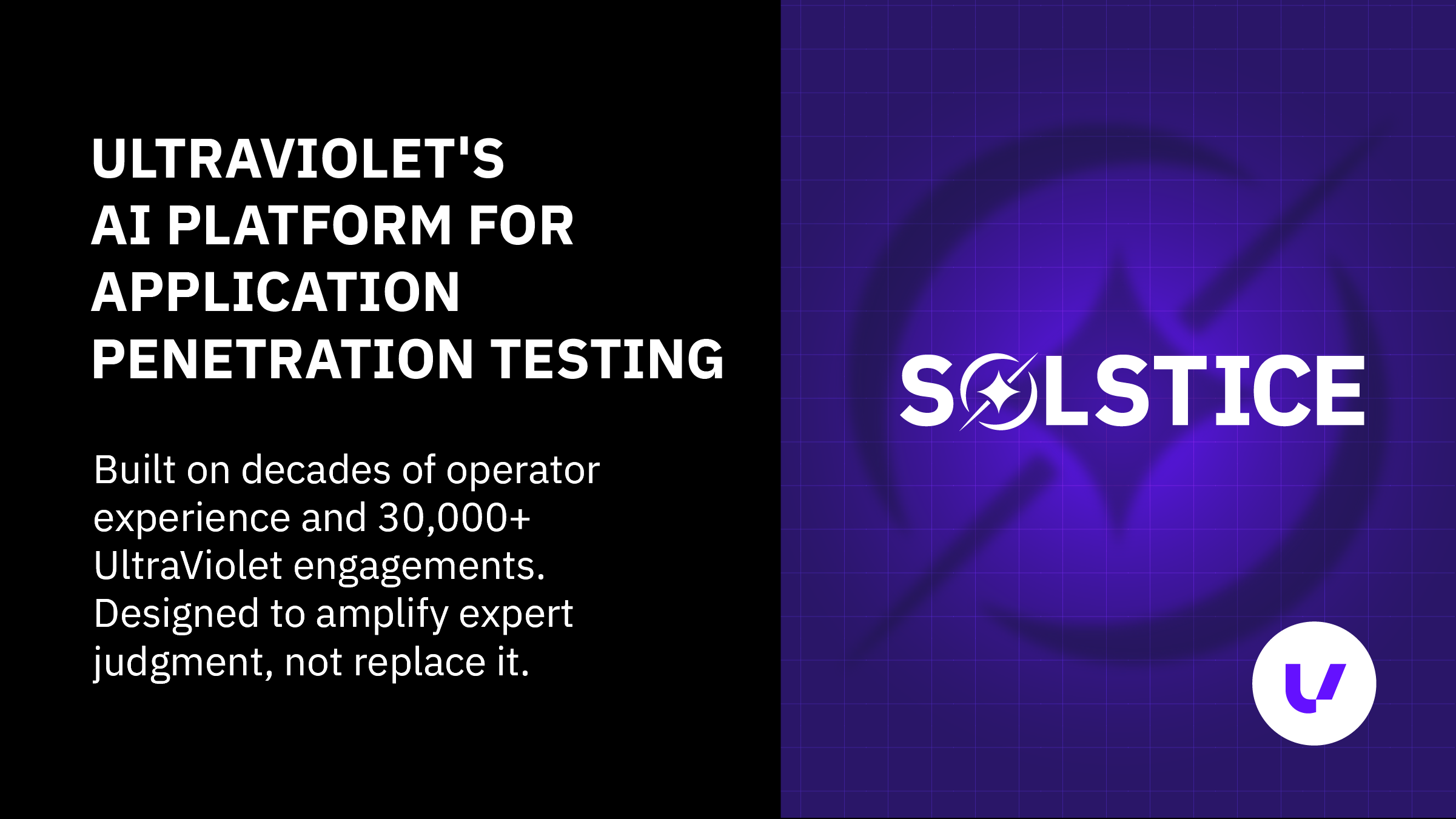
UltraViolet Cyber Launches Solstice