The AI SOC Hype Cycle
AI agents won't fix a broken SOC. UltraViolet CEO Ira Goldstein on why Detection-as-Code, unified telemetry, and adversary simulation are the AI SOC strategy.
Every major enterprise is integrating AI into core operations. But AI doesn’t just increase productivity. It concentrates privilege, expands attack surface, and automates risk. If your AI systems are secured the same way as legacy software, you are blind to the most dangerous behaviors.
UltraViolet Cyber provides security services across the AI lifecycle, combining strategy, threat modeling, adversarial testing, monitoring, and training to support secure AI adoption.
AI systems are dynamic, probabilistic, and continuously evolving.
That changes how risk must be managed.
AI introduces a distinct operational risk profile embedded directly into enterprise systems, data pipelines, and decision flows. As models, agents, and automation scale across the organization, security must operate continuously and in alignment with how AI behaves in production environments.
Privileged API chaining
Goal hijacking and unintended execution
Prompt injection attacks
Lateral movement through AI integrations
Data leakage via workflow automation
Model theft and IP exfiltration
GPU and compute targeting
Supply-chain compromise of third-party models
Data poisoning and model manipulation
Hallucinated outputs influencing business decisions
Exposure of regulated or sensitive customer data
Abuse of generative interfaces
Regulatory scrutiny over automated outcomes
AI adoption typically shows up in a consistent set of enterprise initiatives. Each one benefits from clear security outcomes that keep innovation moving.
Privileged access abuse, data leakage, unintended actions.
AI penetration testing and adversarial evaluation to identify security gaps across models, APIs, and workflows.
Expanded attack surface, misconfigurations, inconsistent controls across environments.
Validate AI pipelines and cloud integrations through continuous testing and targeted assessments.
High-value infrastructure targeted for IP theft, supply-chain compromise, and disruption of critical compute resources.
Continuous monitoring of AI platforms to detect and investigate anomalies, plus risk-informed hardening guidance.
Model manipulation, data poisoning, and regulatory exposure as AI impacts business outcomes.
Adversarial model evaluation to understand behavior under malicious inputs and corrupted data, paired with governance and controls.
Customer data exposure, prompt injection abuse, and reputational risk from AI-generated errors or misuse.
Test AI-enabled applications and monitor production signals to detect misuse patterns and runtime anomalies.
Most organizations are pursuing one or more of these AI projects today. Which initiative is your team building right now?
AI penetration testing and adversarial evaluation to identify security gaps across models, APIs, and workflows.
An end-to-end approach to AI security combining strategy, threat modeling, adversarial testing, monitoring, and training to support secure AI adoption.

Define how AI is used, governed, and secured across the organization.
Identify AI-specific attack paths before systems go live.
Simulate how adversaries will target AI systems in practice.
Continuously monitor AI-enabled systems in production.
Equip teams to build and operate AI systems securely.
Technology Company Secures Customer-Facing AI Chatbot
Technology
A technology company preparing to launch an LLM-powered chatbot for customer support engaged UltraViolet Cyber to validate the security of the application before broad deployment.
The organization needed assurance that sensitive customer data and backend systems could not be exposed through prompt manipulation or model misuse.
Nonprofit Organization Reduces AI Chatbot Risk
Healthcare & Life Sciences
A nonprofit organization engaged UltraViolet Cyber to assess the security of an internally developed AI-powered customer service chatbot used to assist members.
The team had implemented security controls and wanted to validate that the chatbot could withstand real-world adversarial scenarios.
We secure your AI journey across eight foundational domains.
Unlike siloed providers, we connect offensive validation with continuous defense — creating a closed feedback loop between testing and monitoring.
AI adoption typically shows up in a consistent set of enterprise initiatives. Each one benefits from clear security outcomes that keep innovation moving.
Privileged access abuse, data leakage, unintended actions.
AI penetration testing and adversarial evaluation to identify security gaps across models, APIs, and workflows.
Expanded attack surface, misconfigurations, inconsistent controls across environments.
Validate AI pipelines and cloud integrations through continuous testing and targeted assessments.
High-value infrastructure targeted for IP theft, supply-chain compromise, and disruption of critical compute resources.
Continuous monitoring of AI platforms to detect and investigate anomalies, plus risk-informed hardening guidance.
Model manipulation, data poisoning, and regulatory exposure as AI impacts business outcomes.
Adversarial model evaluation to understand behavior under malicious inputs and corrupted data, paired with governance and controls.
Customer data exposure, prompt injection abuse, and reputational risk from AI-generated errors or misuse.
Test AI-enabled applications and monitor production signals to detect misuse patterns and runtime anomalies.
AI security is defined in production environments where models, agents, and automation interact with live systems and data. UltraViolet brings operational rigor, adversarial depth, and continuous monitoring to ensure those systems perform securely at scale.
AI should accelerate your business, not accelerate unmanaged risk.
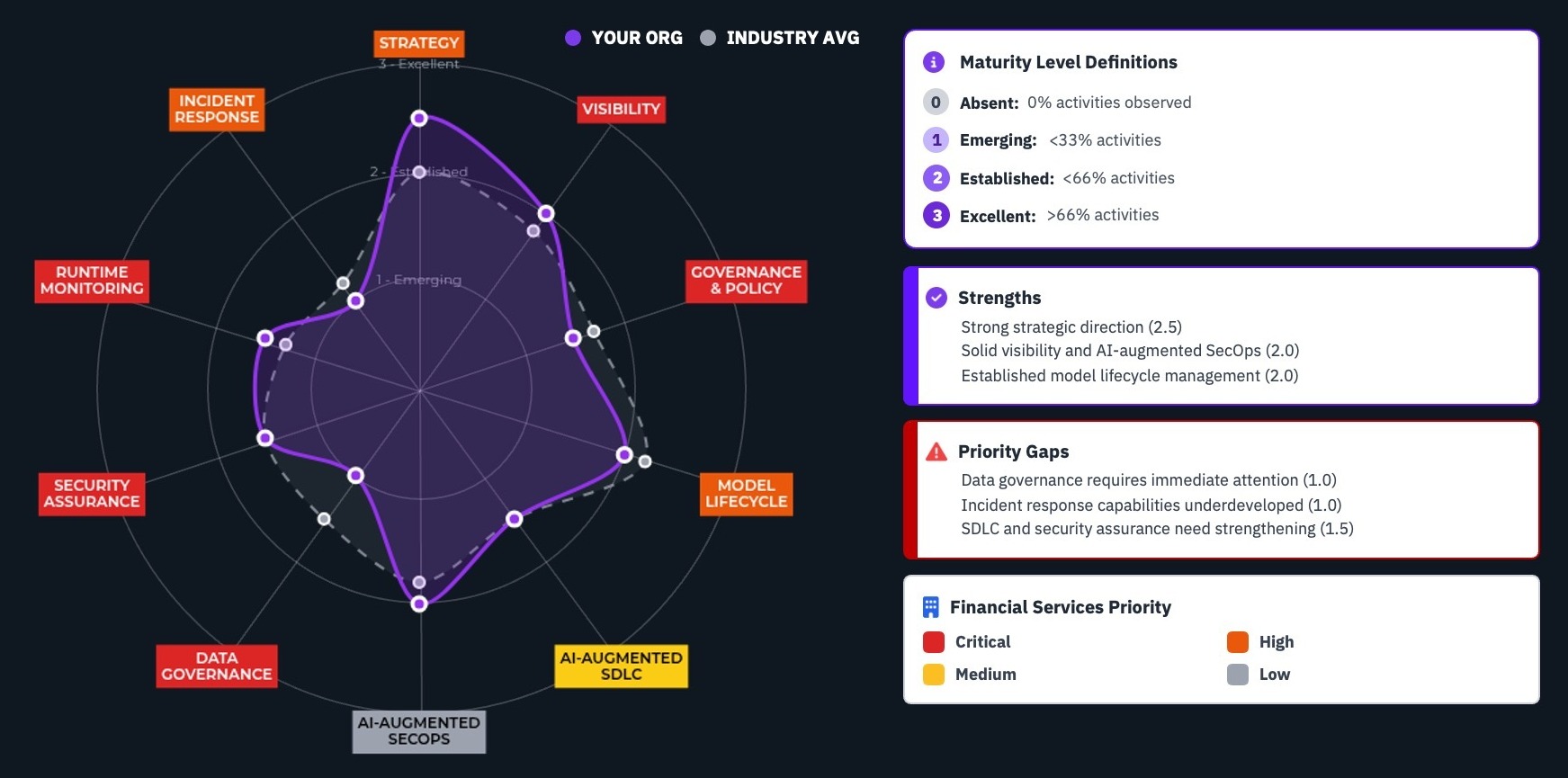
Start with an AI Security Program Assessment to gain a confidential, data-driven view of your current AI security posture, benchmark it against peer organizations, and receive a clear, prioritized roadmap for strengthening governance, engineering controls, and runtime protection.
What You Receive
Confidential AI Security Readout
A private assessment of your organization’s AI security posture across strategy, governance, engineering, assurance, and runtime monitoring domains.
Benchmarking Against Peers
Comparative insights showing how your industry approaches AI risk, highlighting where you lead and where additional focus may be required.
Practice-Level Maturity Scoring
Clear visibility into progression signals across key practices such as data governance, model lifecycle management, AI-augmented SDLC, runtime monitoring, and incident response.
Activity-Level Gap Analysis
Binary visibility into which specific security activities are performed today and which are not — translating AI strategy into observable controls.
Prioritized Improvement Roadmap
A structured progression model outlining practical next steps to move from Emerging to Established maturity levels.
Not every MSSP is ready for AI.
Download this guide to learn the six capabilities your provider needs to secure AI systems and how to assess your current coverage.