Skip to content
Blog

OWASP Top 10 2025 and What It Means for Modern AppSec Programs

John Waller | Cloud & Security Practice Lead

December 1, 2025

To remain relevant and address emerging threats, leading security frameworks routinely update their guidelines and best practices. The OWASP Top 10 is no exception – it evolves to reflect the most critical risks facing modern applications. The latest update, announced as a Release Candidate (RC1) in November 2025, introduces significant changes aligned with today’s software reality. While this RC is not yet final, OWASP has confirmed that only minor refinements are expected before publication. What follows is an overview of the updates in the OWASP Top 10:2025 and how these changes reflect today’s threat landscape.

The Big Shift: From Code to Ecosystem

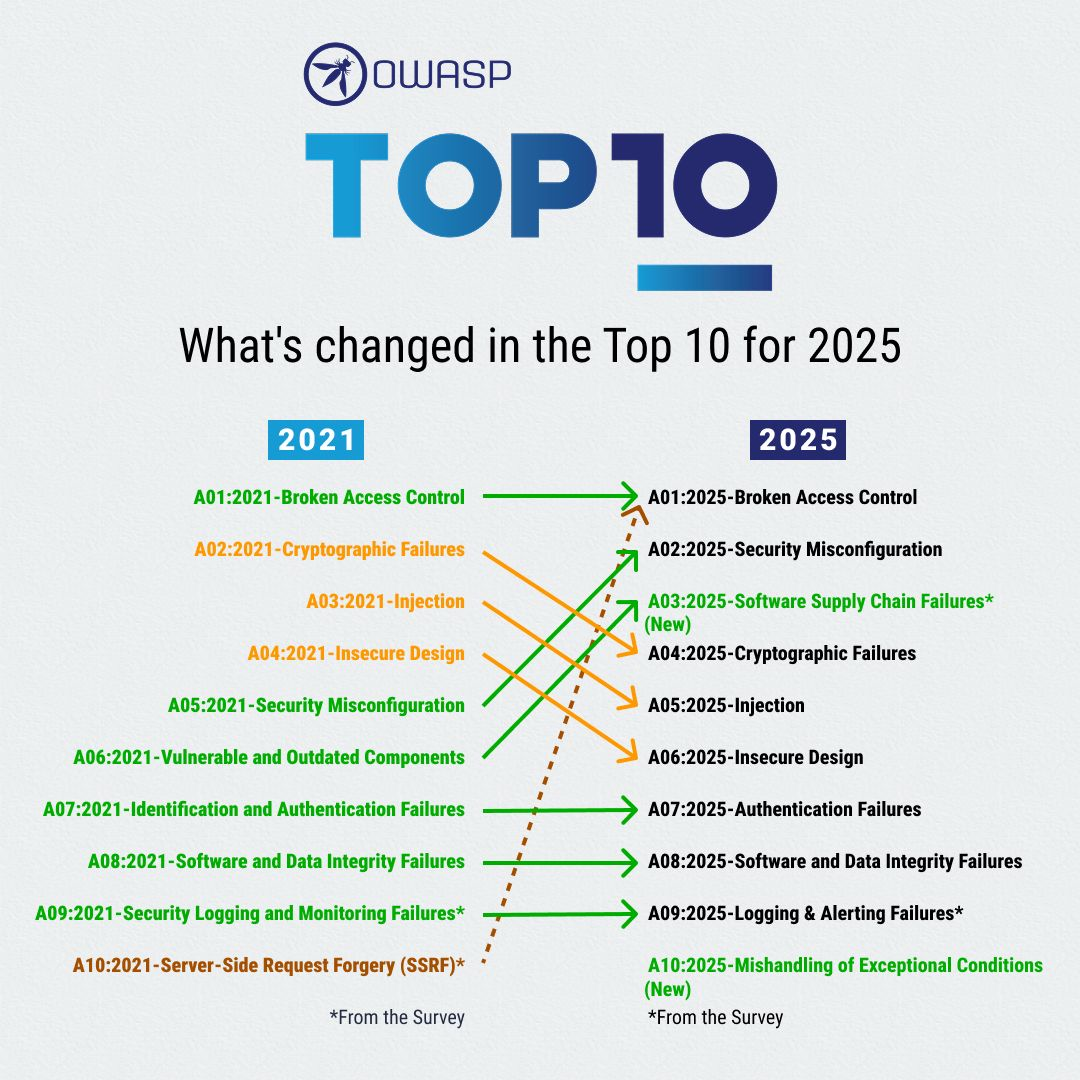
The OWASP Top 10 has always been the benchmark for application security priorities. The 2025 RC1 marks a turning point: while traditional flaws like Broken Access Control and Injection remain, the list now emphasizes systemic and ecosystem-level risks.

Key changes include:

  • Software Supply Chain Failures (new) – This category addresses risks in dependencies, CI/CD pipelines, and build integrity. Attackers increasingly exploit weak links in the software supply chain, making early detection and continuous monitoring essential.
  • Mishandling of Exceptional Conditions (new) – Poor error handling and resilience gaps create opportunities for denial of service and data exposure. This addition highlights the need for secure failure modes and robust operational stability.
  • Security Misconfiguration jumps to #2 – Misconfigurations in cloud and container environments are now among the most critical risks. Their prevalence and impact demand automated assurance and policy-as-code approaches.
  • SRF merged into Broken Access Control, and Vulnerable Components replaced by broader supply chain coverage – These changes consolidate related risks and expand the focus beyond outdated components to systemic supply chain threats. This shift reflects the growing complexity of modern application ecosystems and the need for holistic security strategies.


image-12 Diagram courtesy of OWASP

This evolution signals that application security is no longer just about fixing bugs – it’s about safeguarding the entire software lifecycle. While secure design and supply chain integrity have long been promoted as best practices, the ubiquity and adherence to the OWASP Top 10 mean these priorities are now effectively required by this updated standard. Organizations must adopt a holistic approach that integrates security into design, development, deployment, and operations to stay aligned with this new reality.

Why This Matters

Organizations can no longer rely on patching vulnerabilities after deployment; they need proactive strategies that address risk across the entire software lifecycle. These four realities explain why the latest OWASP changes matter:

  • Attack Surface Explosion - Modern apps depend on third-party libraries, registries, and automated pipelines. A single compromised dependency can cascade into a breach.
  • Resilience as a Security Requirement - Fail-open logic and brittle error handling can lead to denial of service or data exposure. Operational stability is now a security priority.
  • Configuration Risk at Scale - Dynamic environments amplify misconfiguration risk. Automated assurance and policy-as-code are essential.
  • Compliance Pressure - Regulators increasingly demand proof of supply chain security and operational resilience – areas OWASP now highlights.

UltraViolet Cyber: Built for the 2025 and Beyond

UltraViolet Cyber delivers a unified security platform combining Managed Detection and Response (MDR), vulnerability management, penetration testing, and red teaming – and with our August 2025 acquisition of Black Duck’s Application Security Testing (AST) team, we’ve greatly expanded our expertise in SAST, DAST, SCA, DevSecOps engineering, and security consulting.

What This Means for You

  • Supply Chain Defense: Deep SCA and CI/CD pipeline security assessments to prevent dependency and build compromises.
  • Secure-by-Design: Threat modeling and architecture reviews to eliminate systemic flaws before deployment.
  • Continuous Testing: Advanced DAST and adversarial simulations for injection and logic flaws.
  • Operational Assurance: MDR-driven detection for misconfigurations, auth failures, and resilience gaps.

By integrating deep AST expertise with our existing offensive and defensive capabilities, UltraViolet Cyber helps organizations address the OWASP 2025 shift head-on – from code-level vulnerabilities to ecosystem-wide risk.

Turn OWASP 2025 Into Your Advantage

The OWASP Top 10 for 2025 makes one thing clear: security must extend beyond code to the systems that build and run it. UltraViolet Cyber helps organizations embrace this reality by combining enhanced application security expertise with unified security operations. Together, these capabilities deliver measurable risk reduction across the entire software lifecycle.

Explore Application Security Services