Skip to content

The Complete SIEM Migration Checklist

Most SIEM migrations fail long before execution because of gaps in planning, data strategy, and stakeholder alignment. This checklist gives you a clear, operator-level framework to de-risk your migration and ensure measurable outcomes from day one.
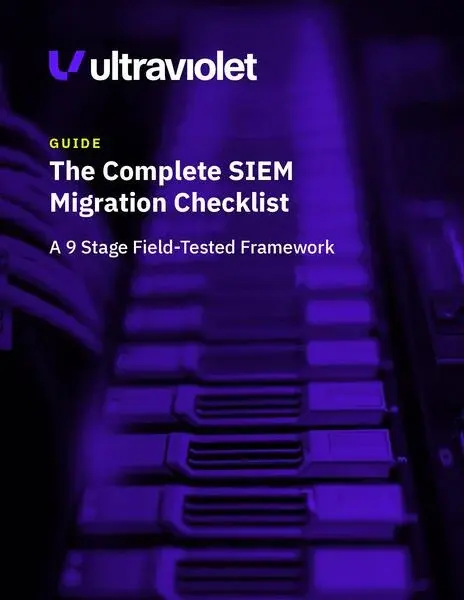
Guide - Thumbnail - SIEM Migration Checklist

Most SIEM Migrations Break What Matters

SIEM migrations are often driven by cost, platform consolidation, or the need for better analytics. But the real risk isn’t moving data. It’s what happens to detection.

This checklist will give you insights into how to:

  • Discover how to document vendor-specific log format variations early to avoid the common engineering "surprises" 
  • Learn how to identify and retire legacy detections and dashboards that haven't fired in months
  • See the specific procedures for managing log sources that do not support parallel shipping
  • Explore the step-by-step process for tuning alert thresholds in a staging environment to ensure your new platform delivers high-signal alerts
  • and more....

Even well-planned migrations introduce operational risk. And most teams only realize it after cutover.

What You Get From a SIEM Migration Engagement


Structured Migration Governance
Defined milestones, stakeholder alignment, and clear reporting.
Detection Health Assessment

Full evaluation of existing rules, dashboards, and coverage.

Optimized Detection Engineering

Migration, tuning, and enhancement of detection logic.

Validated Data Coverage

Verified log sources, ingestion pipelines, and visibility.

Performance Assurance

End-to-end validation of dashboards, queries, and reporting.

Future-Ready Architecture

SIEM design aligned to scalability, maintainability, and cost efficiency.

Operational Transition Support

Runbooks, workflows, and guidance for ongoing operations.

How We Execute SIEM Migrations Without Disruption

Our methodology is proven in complex, deadline-driven environments where maintaining detection coverage during migration is critical.

Assess Current Environment
Perform a comprehensive discovery of the existing SIEM, validating data sources, ingestion methods, dashboards, alerts, and operational integrations.
Planning & Scope Validation
Align stakeholders, document security and compliance requirements, and define the migration roadmap, milestones, and cutover priorities.
Architecture Review & Parallel Log Shipping
Evaluate the current architecture, design the target SIEM environment, and establish parallel ingestion to verify data integrity and coverage.
Content Migration & AI Optimization
Deploy the platform, migrate and enhance detection rules, and apply AI driven analytics to improve signal quality and reduce noise.
Validation & Decommissioning
Conduct structured testing and stakeholder validation to ensure operational readiness before retiring legacy infrastructure.
Maintenance & Sustainability
Provide training, documentation, and runbooks to ensure teams can operate, tune, and sustain the SIEM long after migration.

What Success Looks Like

check icon

Maintained or improved detection coverage from day one

check icon

Reduced alert noise and analyst fatigue

check icon

Verified visibility across cloud, network, and endpoints

check icon

Faster investigation and response workflows

check icon

Lower total cost of ownership post-migration
Built By Operators Who Run Security at Scale

Built for Operations, Not Just Migration

Our work is led by highly certified practitioners who build and run SIEMs daily. Migration success is measured by postcutover performance, not project completion.

Detection-First Execution

We focus on detection quality, alert relevance, and response readiness throughout the engagement.


Proven at Scale
UltraViolet has executed large-scale SIEM migrations involving hundreds of dashboards, thousands of detection panels, and immovable business deadlines.


The Complete SIEM Migration Checklist:

A 9 Stage Field-Tested Framework
Guide - Thumbnail - SIEM Migration Checklist

REAL-WORLD RESULTS

We Treat SIEM Migration as a Detection Engineering Problem

Every engagement is led by practitioners who:

  • Build and operate detections at enterprise scale

  • Understand adversary behavior and MITRE-aligned detection logic

  • Have experience across legacy and modern SIEM platforms

Result:
A platform aligned to how your security team actually operates.

At UltraViolet Cyber, SIEM migration is not handled as a lift-and-shift exercise. It’s a full detection lifecycle transition.