Skip to content
Blog

The Deployment Gap: Why AI Is Moving Faster Than the Governance Programs Built to Manage It

The data is consistent across every major survey published in the last twelve months: organizations are deploying AI at scale — into customer-facing workflows, security operations, software development pipelines, and increasingly autonomous decision systems. Employees are using it regardless of whether their organization has sanctioned it, and the governance programs designed to manage that deployment are, by every available measure, not keeping pace.

This is not a prediction. It is the current state of enterprise AI.

The 2025 CSA–Google Cloud State of AI Security and Governance survey found that only 26% of organizations have comprehensive AI security governance policies in place. The 2026 Verizon Data Breach Incident Report found that Shadow AI is now the third most common non-malicious insider action detected in DLP data — a fourfold increase from the prior year — with 67% of users accessing AI services through non-corporate accounts on corporate devices. A February 2026 Gartner analysis found that organizations deploying AI governance platforms are 3.4 times more likely to achieve high effectiveness in AI governance than those that do not. And a Notable Capital survey of nearly 150 CISOs found that 54% rate their tooling for securing AI workloads as early-stage or very immature.

26% of organizations have comprehensive AI security governance policies (CSA–Google Cloud, 2025)
3.4× more likely to achieve high governance effectiveness with a dedicated platform (Gartner, 2026)
54% of CISOs rate their AI workload security tooling as early-stage or very immature (Notable Capital, 2025)
67% of users access AI services through non-corporate accounts on corporate devices (Verizon DBIR, 2026)

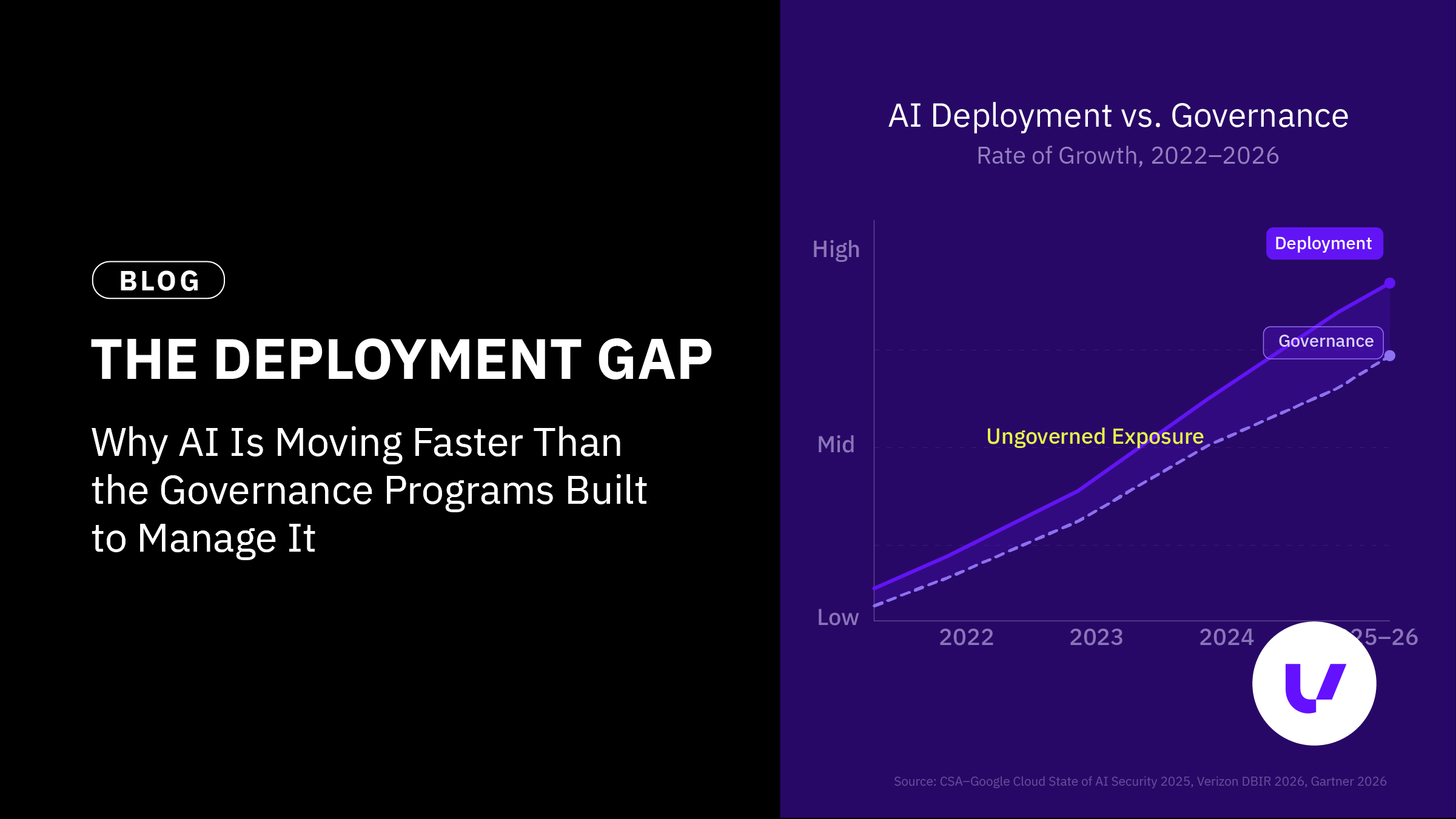
The pattern is not ambiguous. Deployment is accelerating, while governance is not. The distance between those two lines is where organizational risk lives.

High Mid Low 2022 2023 2024 2025–26 Deployment Governance Ungoverned exposure Source: CSA–Google Cloud State of AI Security 2025, Verizon DBIR 2026, Gartner 2026

AI deployment is accelerating while governance lags. The widening gap between those two trajectories is where organizational exposure accumulates.


Deployment without governance is not innovation — it is exposure

The instinct in most organizations is to frame governance as a brake on adoption. Move fast, govern later. Get the capability in production, build the controls once the use cases are proven. This framing is operationally wrong.

The CSA data shows that organizations with comprehensive governance policies are twice as likely to adopt agentic AI confidently, three times more likely to train staff on AI security tools, and twice as confident in their ability to protect AI systems in production. Governance is not what slows adoption down. Governance is what makes confident, scalable adoption possible.

Organizations operating without it are not moving faster in any meaningful sense. They are accumulating exposure they cannot yet measure. The 2026 DBIR found that the most common data type submitted to unauthorized external AI models is source code, followed by structured data. That is intellectual property and operational data leaving the organization through a channel most security teams cannot see. Shadow AI is not a fringe behavior — it is the default when governance has not provided a sanctioned path that is easier than the unsanctioned one. 45% of employees are now regular AI users on corporate devices, authorized or not, up from 15% the prior year. That trajectory does not flatten on its own.


The controls inheritance problem

Most organizations are not governing AI poorly because they are indifferent to risk. They are governing it poorly because they are applying the wrong mental model.

AI workloads are being treated as an extension of cloud infrastructure — with controls inherited from cloud governance mapped onto architectures those controls were not designed to manage. Probabilistic systems do not fail the way deterministic ones do. Prompt injection is not a misconfiguration. Model drift is not a patch cycle. Data poisoning introduced during fine-tuning does not surface in a vulnerability scan. These are not technology gaps; they are governance gaps.

Traditional controls built for deterministic software AI-specific risks invisible to inherited controls Vulnerability scanning Finds known CVEs in code DLP controls Inspects files and network traffic Patch management Remediates known software flaws Access controls Governs human identities Data poisoning Introduced during fine-tuning Prompt injection Input-layer manipulation Model drift Behavior shifts in production Agentic privilege escalation Non-human identities at scale

Traditional security controls were designed for code-based, deterministic systems. They have no visibility into AI-specific failure modes.

The CSA survey makes this concrete: only 21% of respondents flag model-level risks — data poisoning, prompt injection, model manipulation — as key concerns. The remaining organizations are focused on data exposure and regulatory compliance, which are legitimate concerns, but they are the familiar ones. The risks that sit at the model layer, specific to how AI systems actually behave, are not yet in most organizations' threat models. Gartner is direct on the consequence: traditional GRC tools are simply not equipped to handle the unique risks of AI, and point-in-time audits are insufficient when AI systems are making autonomous decisions continuously.


The executive visibility gap

There is a second gap the data surfaces, and it is less about tooling than alignment.

Executive enthusiasm for AI is not matched by executive understanding of what securing it requires. The CSA survey found that 72% of respondents are neutral or not confident in their organization's ability to execute an AI security strategy — a dramatic reversal from 2024, when a majority rated themselves confident or very confident. That shift does not reflect growing incompetence. It reflects growing clarity about the actual depth of the problem as AI moves from pilot to production. Most organizations do not have a clear line between the board's AI ambitions and the security team's actual capability to govern what gets deployed.

AI governance has not yet been given the same board-level framing as financial risk or regulatory compliance. It is treated as a technical concern, delegated to security teams who are simultaneously being asked to adopt AI themselves while building the governance infrastructure to manage enterprise-wide deployment.

That is not a sustainable operating model.


The regulatory floor is rising

One dimension of this problem that has not yet fully registered in most enterprise security programs is the regulatory trajectory. Gartner projects that by 2030, AI regulation will extend to 75% of the world's economies, driving $1 billion in total compliance spend — with $492 million of that arriving in 2026 alone. The EU AI Act is in force, the NIST AI RMF is a baseline in a growing number of regulated industries, and ISO 42001 is becoming a procurement requirement in enterprise vendor assessments.

Organizations building governance infrastructure now are not just managing today's risk. They are building the compliance posture tomorrow's regulatory environment will require. Gartner finds that effective governance technologies could reduce regulatory expenses by 20% compared to organizations managing compliance reactively. Governance built ahead of the regulatory requirement is a capability; governance built in response to an enforcement action is a cost.


The gap is closable

None of this is insurmountable. The same data that documents the gap also documents what closing it looks like. Where governance is in place, outcomes improve consistently — more confident adoption of advanced capabilities, stronger board alignment, better staff preparedness, and higher confidence in the security of AI systems in production.

The gap is not a technology gap. The tooling exists: AI governance platforms, model risk management frameworks, AI-aware CNAPP capabilities, identity governance extended to non-human actors. What most organizations lack is the governance architecture to deploy those tools with purpose, and the organizational commitment to treat AI governance as a foundational capability rather than a compliance checkbox.

No governance AI deployed, no controls, no visibility Reactive governance Policy docs, periodic audits, no architecture fit Architecture-aware Controls matched to AI system type governance maturity Outcomes Unmeasured exposure No audit trail Shadow AI default Regulatory liability Outcomes Checkbox compliance Point-in-time audits AI risks still blind Slow agentic adoption Outcomes 2× faster agentic adoption Reconstructable decisions Board-level alignment Regulatory posture built Source: CSA–Google Cloud State of AI Security and Governance, 2025

Where governance architecture is in place, organizations adopt agentic AI twice as fast and achieve meaningfully stronger security and compliance outcomes.

Deployment has already happened, at scale, across every industry. The work now is building the discipline to govern what has been deployed. The organizations that close this gap will not just reduce their exposure — they will be the ones that can adopt the next wave of AI capability with confidence because the infrastructure to do so responsibly will already be in place.

UltraViolet Cyber helps security leaders assess where their AI governance program stands today — and what it takes to close the gap. Our AI Security Program Assessment maps your current controls against the architectures you're actually running.

Schedule an AI Security Program Assessment