Threat Advisory: DPRK Social Engineering Attacks
APT37 has deployed NarwhalRAT, a fileless Python RAT using pCloud for C2. Read the TIDE Team's full analysis and response guidance for Microsoft 365 environments.
Find flaws in AI Systems
Find flaws in web, mobile, and IoT applications.
Live-fire exercises to sharpen detection and response.
Time-boxed security assessments across networks, apps, and infrastructure.
Simulated attacks to test detection and incident response.
Named security experts integrated seamlessly into your team.
Real-time detection and automated threat response.
24x7 monitoring and response by expert analysts.
Detection-focused SIEM migration without visibility gaps.
UltraViolet's proprietary AI platform powering all application penetration testing.
Unified security platform powering all UV services.

Cross-platform toolkit for advanced red team ops.
UltraViolet Cyber provides security services across the AI lifecycle, combining strategy, threat modeling, adversarial testing, monitoring, and training to support secure AI adoption.
Learn how a major U.S. airport operator achieved 24/7 threat detection, improved security maturity, and ...

Secure your code, infrastructure, and deployment pipelines before attackers exploit them.
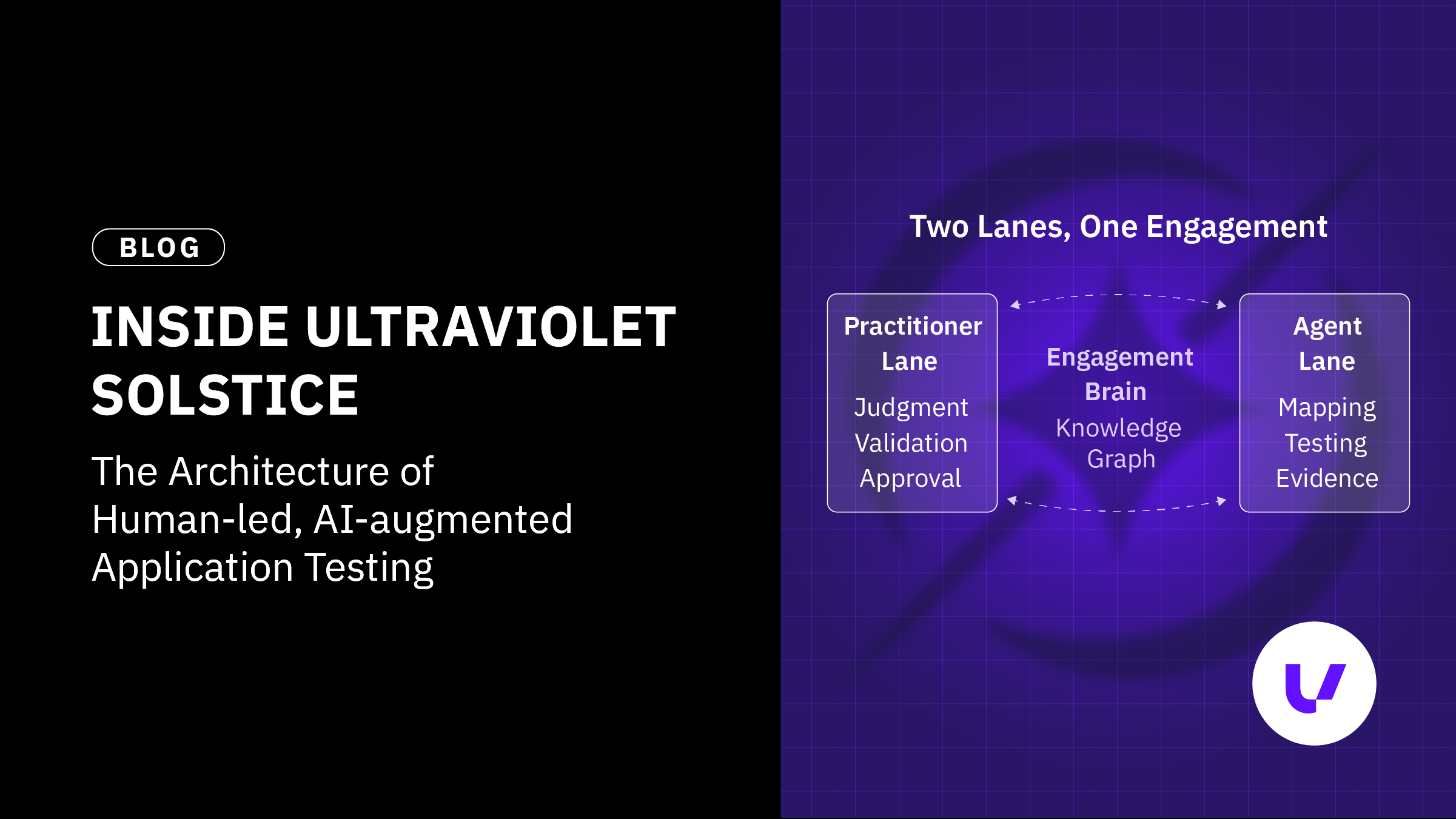
Inside Solstice, UltraViolet Cyber's AI-augmented application penetration testing platform: how the two-lane engagement ...

AI Governance by DesignAn Architecture-Aware Approach for Embedding Governance into AI Systems

UltraViolet Cyber is a practitioner-led MSSP delivering offensive and defensive security to Global 2000 and Federal clients. Built by former intelligence operators, we unify application security, red teaming, detection, and engineering under one roof. Our UV Lens platform replaces silos with integrated, outcome-driven operations.
Validate risk through objective-based adversary simulation across electronic, social, and physical domains. Named senior operators validate every finding with evidence and context, so your team gets a deliverable precise enough to act on and defenses sharpened by every engagement.
Offensive engagements per year
Typical objective-based engagement duration.
Findings validated with evidence and reproduction steps
Securing the world's most complex organizations
Follow real attack paths across critical systems to prove what an adversary could accomplish, where defenses break down, and what to fix first. Use that evidence to prioritize controls, justify budget, and communicate risk based on what an attacker actually achieved.
Build trust into every engagement. Named senior operators work inside sensitive environments under clear rules of engagement, giving your team real-time clarity into who is testing, what they are doing, and what they find.
Turn every engagement into defensive action. Offense feeds validation, defense integrates what the engagement uncovers, and the readout sets the starting line for what your next red team has to break.
-png.png?width=2400&height=738&name=Editable%20Design%20for%20Recent%20-%20Red%20Teaming%20Process%20(5)-png.png)
Extend adversary-driven testing to your AI and ML systems across models, pipelines, and supporting platforms. Operators assess prompt manipulation, model exploitation, misalignment, and data leakage paths, using AI to accelerate OSINT and reconnaissance while human experts drive the tradecraft, validate every finding, and decide what an attacker would do next.
Testing Fraud Controls Against Real Adversary Behavior
Data Annotation Company
A data annotation company needed to validate whether its contractor onboarding platform could withstand fraud attempts, credential theft, and credential selling tied to AI model training workflows. UltraViolet Cyber tested how the customer’s existing controls would perform against realistic bypass attempts and used OSINT to uncover underground activity that could enable fraud.
Proving How an Assumed Breach Could Reach Cardholder Data
Financial Services Company
A large financial services company needed annual testing to satisfy PCI requirements and understand how far an attacker could move from an assumed-breach position inside its corporate network. UltraViolet Cyber started from a provisioned server, conducted reconnaissance, identified a vulnerable web application managing passwords, and used that access to test whether restricted network segments and the cardholder data environment could be reached.
The engagement showed how one unpatched application could become a path to sensitive systems, giving business stakeholders clear evidence of risk and the value of objective-based testing.
Engagements follow recognized methodology and evidence standards your auditors and regulators already use, so the readout supports compliance, leadership, and board review.
Move from objective to action. Every engagement starts with planning and rules of engagement, runs against a defined objective, and ends with a structured deliverable your team and SOC can both act on.
State-sponsored cyber activity is no longer limited to intelligence gathering; it now spans disruption, destruction, influence, and financially motivated operations that directly impact businesses and critical infrastructure.
In this webinar, Dan Gittis, Director of the TIDE (Threat Intelligence & Detection Engineer) Team, provides a structured, real‑world overview of how nation-state cyber operations are evolving and why understanding adversary motives is critical to effective defense.
Learn more about Red Teaming
Talk with a practitioner about the attack paths worth testing, the objective worth proving, and the evidence your team needs to act with confidence.